
Your residence card
The main ID for foreign residents (在留カード, zairyu card). Short-term visitors without one generally can't open a regular account.
Sooner or later, Japan wants you to have a local bank account. Your salary goes into it, your rent often comes out of it, and plenty of everyday services expect one. Opening it is mostly a question of doing things in the right order: address first, then phone, then bank. Here's how it usually works for newcomers, and what to do when a bank says no.
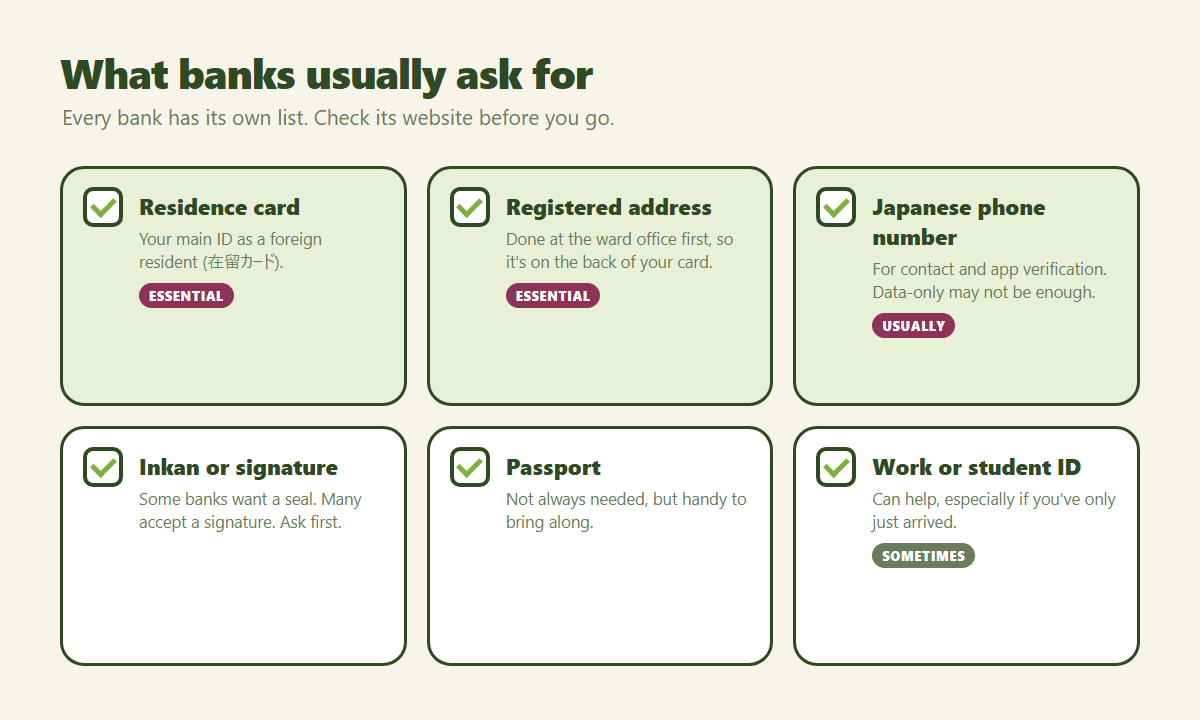
The main ID for foreign residents (在留カード, zairyu card). Short-term visitors without one generally can't open a regular account.
Banks want the address on the back of your residence card, so register at the ward office first. Some also ask for a copy of your residence record (住民票, juminhyo).
Most banks want a local number to contact you and to verify you in their app. A data-only SIM without a number may not be enough.
Some banks ask for a personal seal (inkan) to register with the account. Many now accept a signature instead, especially for foreign residents. Ask the bank which it uses.
Not always required, but it's often handy to bring alongside the residence card.
An employment contract, company ID or student ID can help, especially if you've been in Japan only a short time.
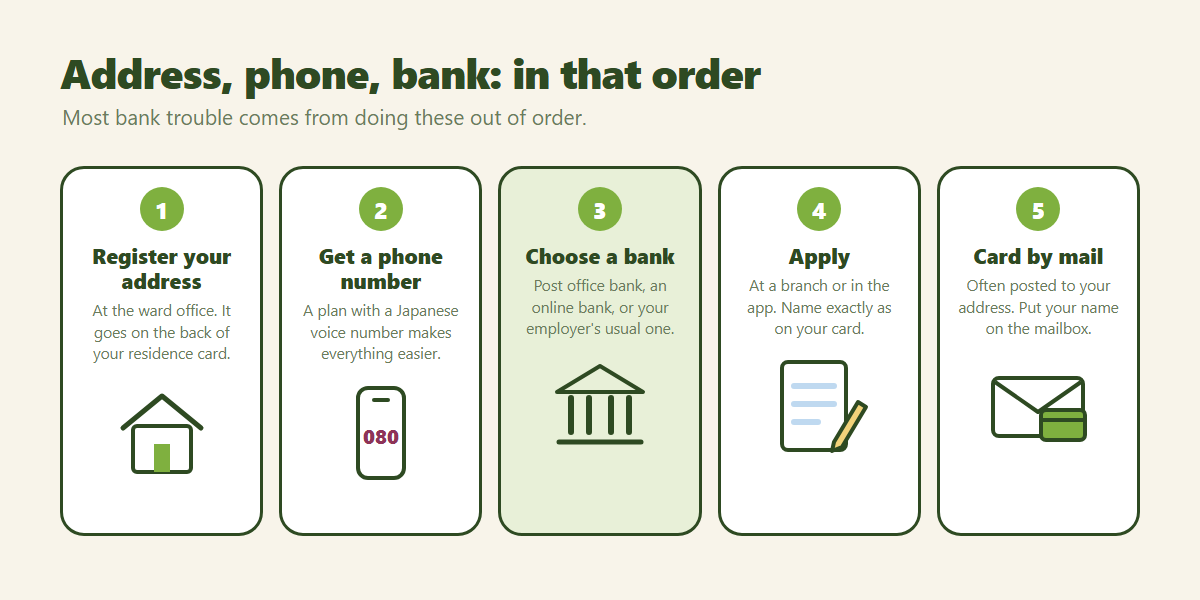
The most common newcomer mistake is going to the bank too early. Banks check that your details line up, so it pays to finish the other setup first. Register your address at the ward office so it appears on your residence card. Then get a Japanese phone number; our SIM and eSIM guide covers the options, including ones that don't need a Japanese bank card to sign up. With your address and number sorted, the bank visit is usually straightforward.
Run through post offices, so there's one near almost everyone. Many newcomers open their first account here. Branch rules and English support vary, so it can help to call or check the website first.
Several online banks let you apply through an app, often with an English option or guide, and verify your ID with your phone camera. Good if you'd rather skip the branch, but you usually need a Japanese phone number and your address registered first.
The major banks have branches everywhere and are widely used for salaries. Some are stricter with people who've only just arrived. If one branch says no, another bank, or the same bank later, may say yes.
Many companies and universities have a bank they usually work with, and sometimes a staff member who can help with the forms. It's often the easiest route of all.
Some banks treat people who have been in Japan for less than six months differently. They may decline a new account, limit what it can do (for example sending money abroad), or ask for proof of employment. Not every bank does this, and the details change, so check with the bank directly. If you hit it, Japan Post Bank, an online bank, or your employer's usual bank is often worth trying, and once you pass six months the doors usually open wider.
With a bank account, the rest of your setup speeds up: rent transfers, phone bills, salary, and paying at the konbini. Our first month in Tokyo guide walks through the rest of the list, seeing a doctor in Tokyo in English covers the health insurance side, and if you're here on a working holiday, the working holiday guide is worth a look. The paperwork phase ends. The fun part, building a life here, starts right after.
Buy Me a Matcha is the only app made for English speakers to make real friends in Japan. See people near your station who also want new friends, send a matcha, and if they send one back, pick a café and meet one-on-one. A much better use of your first payday.
Yes. Foreign residents with a residence card and a registered address can generally open a Japanese bank account. Banks usually also ask for a Japanese phone number and an inkan or signature. Short-term visitors without a residence card generally can't open a regular account.
Usually your residence card with your registered address, a Japanese phone number, and an inkan or a signature. Some banks also ask for your passport, a residence record (juminhyo), or proof of work or study. Each bank sets its own list, so check with the bank.
Some banks treat people who have been in Japan less than six months differently, for example by declining new accounts, limiting features like overseas transfers, or asking for proof of employment. Not every bank does this and the details change, so check with the bank directly.
It depends on your situation. Many newcomers start with Japan Post Bank because there's a post office nearby, or with an online bank that has an English app. Your employer or school may also have a bank it usually works with.
Not always. Many banks accept a signature from foreign residents, while some still ask for an inkan. Ask the bank before you go. If you need one, inkan shops can make a simple seal.