
Your local city hall
Tokyo's 23 wards each have their own office. Outside the wards, the same job is done by a city hall (市役所, shiyakusho) or a town office. You go to the one for the area where you live.
You've found an apartment, the boxes are in, and now there's one more stop: the ward office, or kuyakusho (区役所). It's where you tell your local government you live here, and it unlocks a lot of everyday life, from your residence card address to health insurance. It can feel intimidating the first time, all counters and number tickets, but it's very doable. Here's what to expect, in plain English.
Tokyo's 23 wards each have their own office. Outside the wards, the same job is done by a city hall (市役所, shiyakusho) or a town office. You go to the one for the area where you live.
The main reason for your first visit. You register your new address, and it gets added to your residence card.
If you aren't covered through an employer, this is usually where you sign up for National Health Insurance and get pointed to the pension system.
Later on, it's where you get official copies of your residence record, and handle things like moving out of the ward.
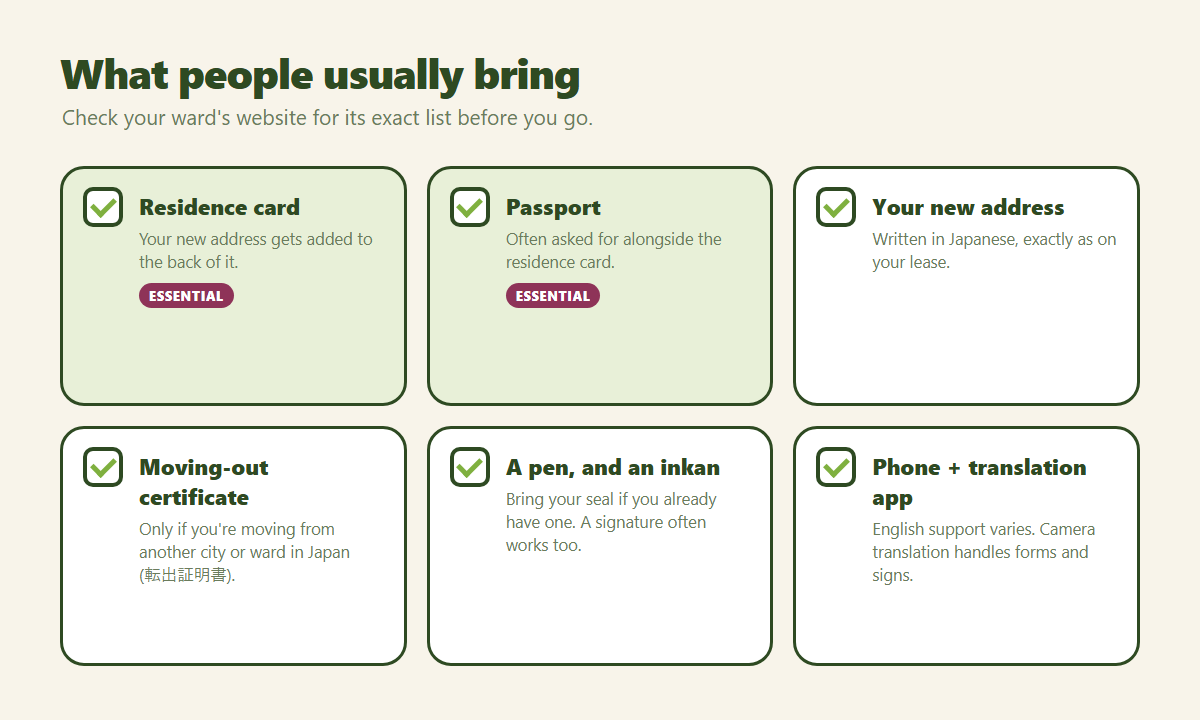
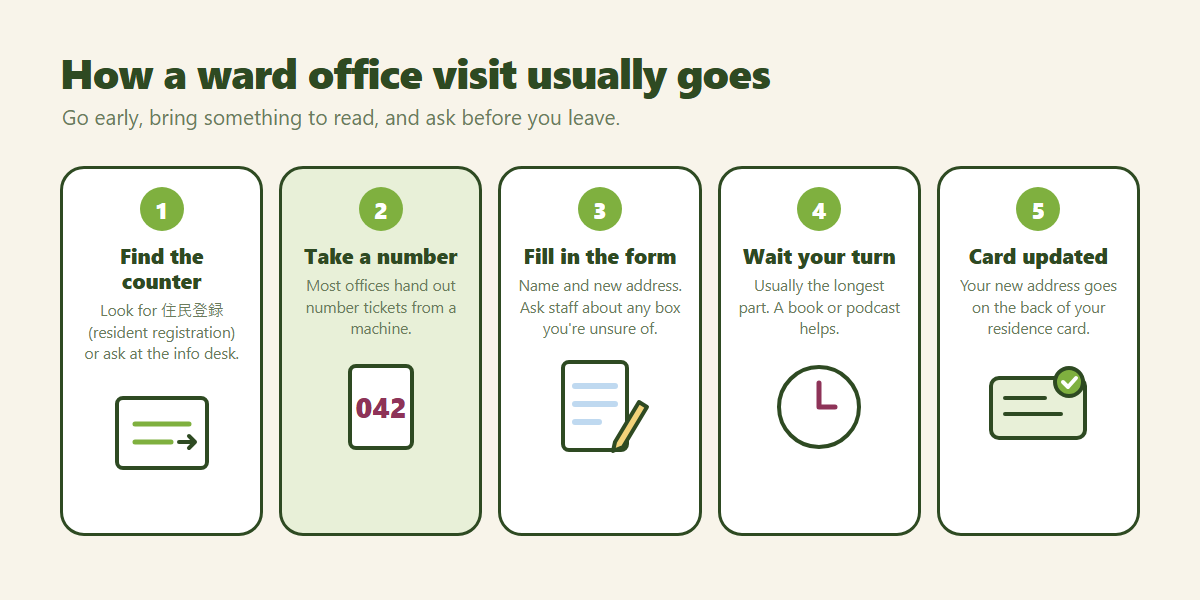
After you move into a new home, you register your address at your local ward office. This is often called the moving-in notification (転入届, tennyu todoke). For people arriving from abroad, it's generally expected within 14 days of moving in, and the same applies when you move within Japan, so don't leave it for later. If you're moving from another city or ward in Japan, you usually need to tell your old office first and bring the moving-out certificate (転出証明書) they give you. Rules and paperwork can differ, so check your ward's website or ask at the counter if anything is unclear.
Residents who aren't on an employer's health insurance usually join National Health Insurance (国民健康保険) at the ward office. Your insurance card is what you show at the doctor.
Residents in Japan are generally part of the national pension system. If you're not enrolled through work, the ward office can explain what applies to you.
Residents get a 12-digit My Number, used for tax, social security and other official paperwork. You can also apply for a My Number card, a photo ID. The ward will explain how it works for you.
Once registered, you can ask for a copy of your residence record (住民票, juminhyo). Banks, phone companies or employers sometimes ask for one.
With your address registered, a lot of other setup gets easier. Our SIM and eSIM guide covers getting a Japanese phone number, the first month in Tokyo guide walks through the rest of your settling-in list, and best neighbourhoods for foreigners helps if you're still deciding where to live. And once the forms are done, celebrate properly: a good matcha near the ward office is a fine reward.
Buy Me a Matcha is the only app made for English speakers to make real friends in Japan. See people near your station who also want new friends, send a matcha, and if they send one back, pick a café and meet one-on-one. Your new neighbourhood is more fun with someone to explore it with.
A kuyakusho (区役所) is a ward office, the local government office for one of Tokyo's 23 wards (and for wards in some other big cities). Residents go there to register their address, join National Health Insurance and handle other local paperwork. Outside the wards, a city hall (市役所) or town office does the same job.
Soon after you move in. For people arriving from abroad, it's generally expected within 14 days of moving in, and the same applies when you move within Japan. Check your ward's website for the details that apply to you.
People usually bring their residence card and passport, their new address written down, and, if moving from another city in Japan, the moving-out certificate from their old office. Your ward's website lists exactly what it needs.
It varies by ward and by counter. Some offices have English-speaking staff, multilingual forms or interpretation by tablet, and others have less. A translation app on your phone helps a lot.
Usually, yes. Residents who aren't covered by an employer's health insurance generally sign up for National Health Insurance at their ward office, often on the same visit as their address registration.