Getting sick in a new country is no fun, and the first visit to a Japanese clinic can feel like a puzzle. The good news: healthcare in Tokyo is good, usually quick, and with your insurance card it's affordable. Plenty of clinics have doctors who speak English, and there are free services to help you find them. Here's how a visit usually works, in plain English.
Before you're sick: get insured
Health insurance is the key
Residents in Japan are generally covered either through an employer's health insurance or National Health Insurance (国民健康保険), which you usually join at the ward office. Sort this out early, not on the day you have a fever.
Your insurance card
You show proof of insurance at reception. That may be a health insurance card or a My Number card registered for health insurance use. Ask your employer or ward office which one applies to you.
You usually pay part of the bill
With insurance, most adults pay 30% of the cost at the counter, and insurance covers the rest. Some groups, like young children and older people, pay less.
Without insurance
You pay the full cost yourself. If you're visiting short-term, travel insurance is what covers you, so keep its details on your phone.
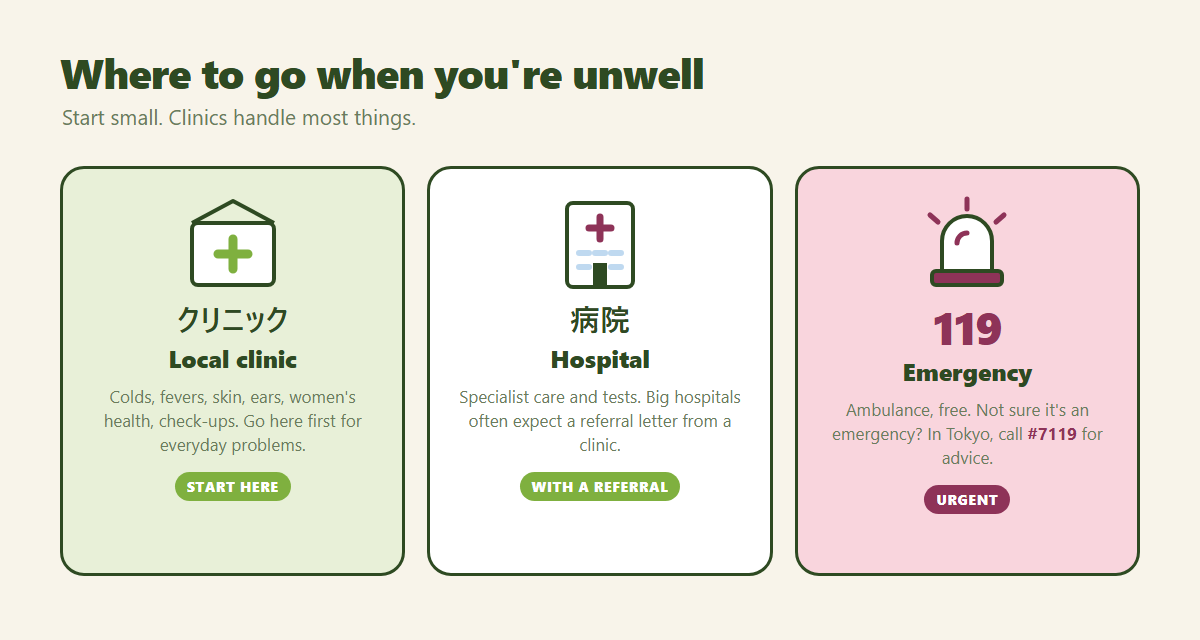
Start small. Clinics handle most things, and hospitals are for referrals and emergencies.
Clinic or hospital?
Clinics (クリニック / 医院)
Small local practices, often specialised: internal medicine (内科) for colds and fevers, dermatology (皮膚科), ENT (耳鼻科), women's health (婦人科) and so on. For most everyday problems, this is where you go first.
Hospitals (病院)
Larger places for specialist care, tests and surgery. Big hospitals often expect a referral letter (紹介状) from a clinic, and may charge an extra fee if you come without one. Check before you go.
Opening hours vary
Many clinics close for a lunch break, close early on one weekday, and are closed on Sundays and holidays. Check hours online before you leave home.
Booking
Some clinics take walk-ins, others want a reservation by phone or online. If you can, book ahead and mention that you'd prefer English.
How to find an English-speaking clinic
Tokyo's Himawari search. The Tokyo Metropolitan Government's medical information service (東京都医療機関案内サービス ひまわり) lets you search clinics by area, specialty and languages spoken, and has a multilingual information line.
AMDA International Medical Information Center. A non-profit that helps foreign residents find clinics that work in their language and explains how Japanese healthcare works, by phone.
JNTO's medical institution list. The Japan National Tourism Organization lists hospitals and clinics that accept foreign patients, with languages shown. Aimed at visitors, but useful for anyone.
Your embassy. Many embassies keep a list of local doctors who speak your language.
Ask people who've been here a while. Coworkers, classmates and friends often have a favourite English-speaking clinic near the station. Word of mouth is a great filter.
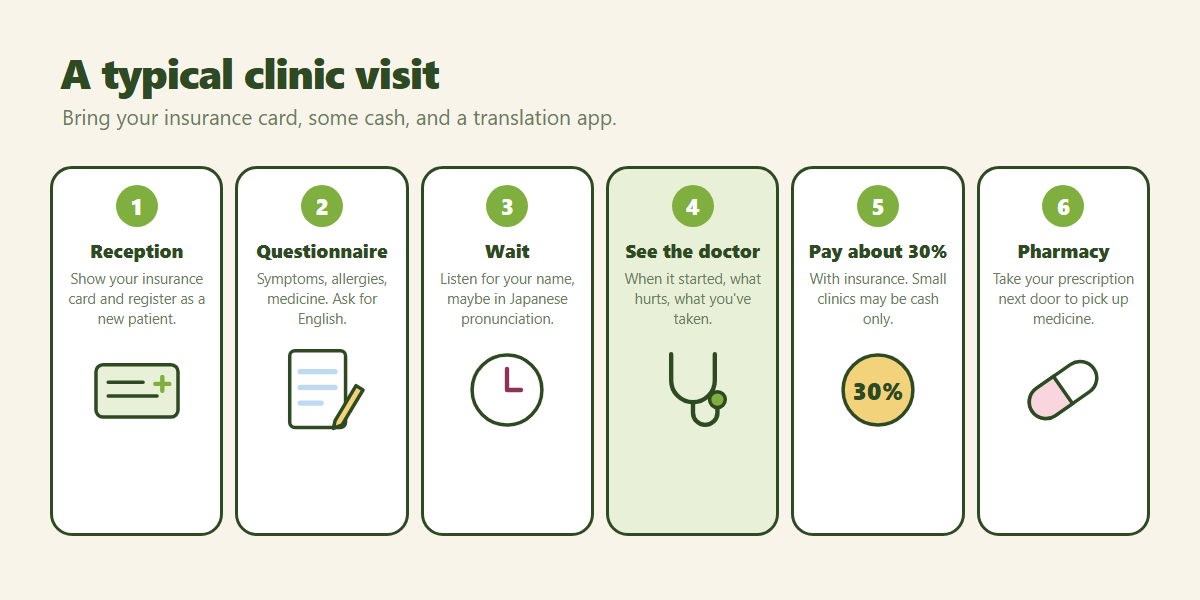
A typical clinic visit, start to finish. Usually quicker than you'd expect.
Your visit, step by step
Check in at reception. Hand over your insurance card. On a first visit you'll usually register as a new patient (初診, shoshin).
Fill in the questionnaire. A short form (問診票, monshinhyo) about your symptoms, allergies and current medicine. Ask if they have an English version; otherwise, camera translation works well.
Wait for your name. Waits vary. Keep an ear out, since your name may be called in Japanese pronunciation.
See the doctor. Explain your symptoms simply: when it started, what hurts, anything you've already taken. Writing it down in advance helps if you're nervous.
Pay at the counter. With insurance, most adults pay 30% of the cost. Smaller clinics may only take cash, so carry some.
Pick up your medicine. If you get a prescription (処方箋), take it to a pharmacy (薬局), often right next door. Prescriptions usually need to be used within a few days.
The pharmacy step
In Japan, many clinics don't hand out medicine themselves. You take your prescription to a pharmacy, show your insurance card, and the pharmacist explains how to take each one. You may be offered a medicine notebook (お薬手帳, okusuri techo), a small booklet or app that records what you've been prescribed. It's worth keeping, since it helps doctors and pharmacists see your history. For mild things like a cold or a headache, drugstores sell over-the-counter medicine, and the pharmacist there can help you choose.
Emergencies: 119 and #7119
119: ambulance and fire
For a real emergency, call 119. The ambulance itself is free. Say "kyukyu desu" (救急です, it's a medical emergency), give your address, and say what happened. Operators can often connect an interpreter.
#7119: not sure if it's an emergency?
In Tokyo, #7119 is an emergency consultation line run by the fire department. Staff help you decide whether you need an ambulance or which hospital to go to. Support is mainly in Japanese, so a Japanese-speaking friend can help.
Night and weekend care
Some hospitals and clinics take urgent patients outside normal hours. The Himawari search can show which ones are open right now.
Keep key info on your phone
Your address in Japanese, insurance details, allergies and any medicine you take. It saves precious minutes if you ever need it.
More of the first-month basics
Health insurance usually comes from the same ward office visit as your address registration, and our bank account guide covers the money side of settling in. The first month in Tokyo guide has the rest of the list. And if you're new here and on your own, moving to Tokyo alone is worth a read. Having a friend nearby who can bring soup when you're sick counts as healthcare too.
The app
Feeling better? Go meet someone
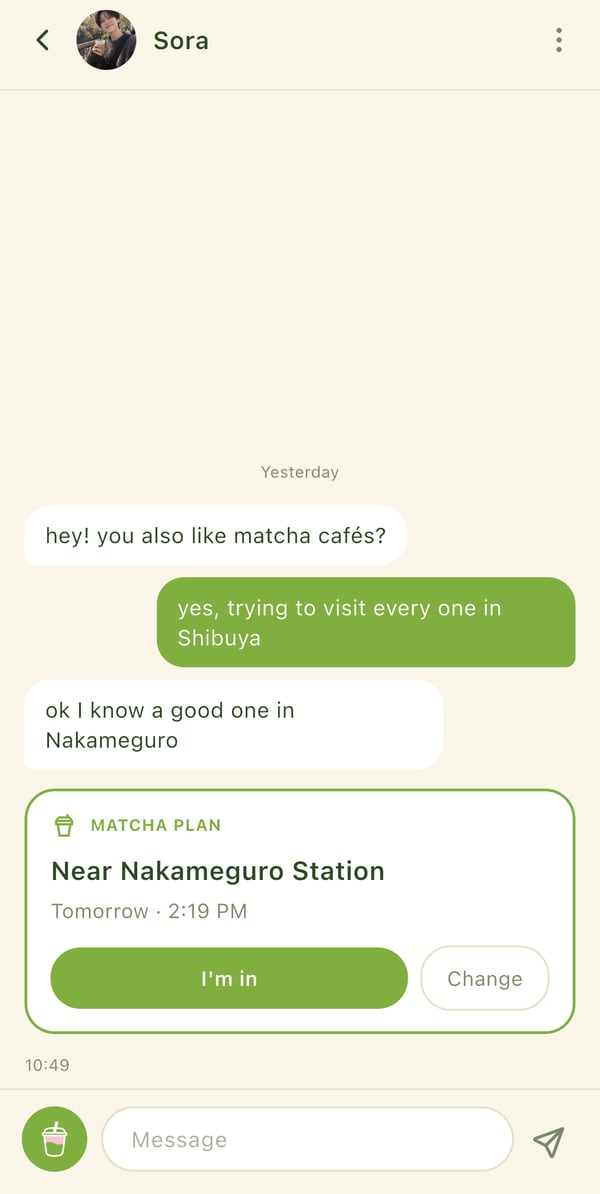
Buy Me a Matcha is the only app made for English speakers to make real friends in Japan. See people near your station who also want new friends, send a matcha, and if they send one back, pick a café and meet one-on-one. The kind of friend who knows a good clinic, and a better café.
How do I find an English-speaking doctor in Tokyo?
Search the Tokyo Metropolitan Government's Himawari medical information service by area and language, call the AMDA International Medical Information Center, or check JNTO's list of medical institutions that accept foreign patients. Your embassy and people who've lived here a while are also good sources.
How much does it cost to see a doctor in Japan?
With Japanese health insurance, most adults pay 30% of the cost at the counter and insurance covers the rest. Without insurance you pay the full amount. Costs depend on the visit, tests and medicine, so check with the clinic if you're unsure.
Should I go to a clinic or a hospital in Japan?
For everyday illness, start at a local clinic. Large hospitals are mainly for specialist care and emergencies, often expect a referral letter from a clinic, and may charge an extra fee without one.
What is the difference between 119 and #7119 in Tokyo?
119 is for emergencies and calls an ambulance, which is free. #7119 is Tokyo's emergency consultation line, where staff help you decide whether you need an ambulance or which hospital to visit. Support on #7119 is mainly in Japanese.
What should I bring to a clinic in Japan?
Your health insurance card (or My Number card registered for insurance), your residence card, cash in case the clinic doesn't take cards, a list of any medicine you take, and a phone with a translation app.