
Rules depend on where you live
Each ward or city sets its own categories, collection days and details. Your friend across town may sort differently from you, and that's normal. Your local chart always wins over any general guide, including this one.
Your first week in a Japanese apartment comes with a small surprise: there is no single bin. Trash here is sorted into categories, each with its own collection day, and the rules come from your local ward or city. It sounds strict, and it is a little, but it becomes second nature fast. Here's how the system works in general, and how to find the exact rules for your address.
Each ward or city sets its own categories, collection days and details. Your friend across town may sort differently from you, and that's normal. Your local chart always wins over any general guide, including this one.
Many apartments get a sorting chart from the landlord, the agent or the ward office when you register your address. If you didn't get one, look on your ward's website or ask at the ward office. Some wards have charts in English.
Some wards and cities have a garbage app or online calendar that reminds you what goes out tomorrow. Search your ward's name plus "garbage" or "ごみ" to see if yours does.
Your building's trash spot or the nearby street corner often has a sign listing the days for each category. Take a photo of it on day one.
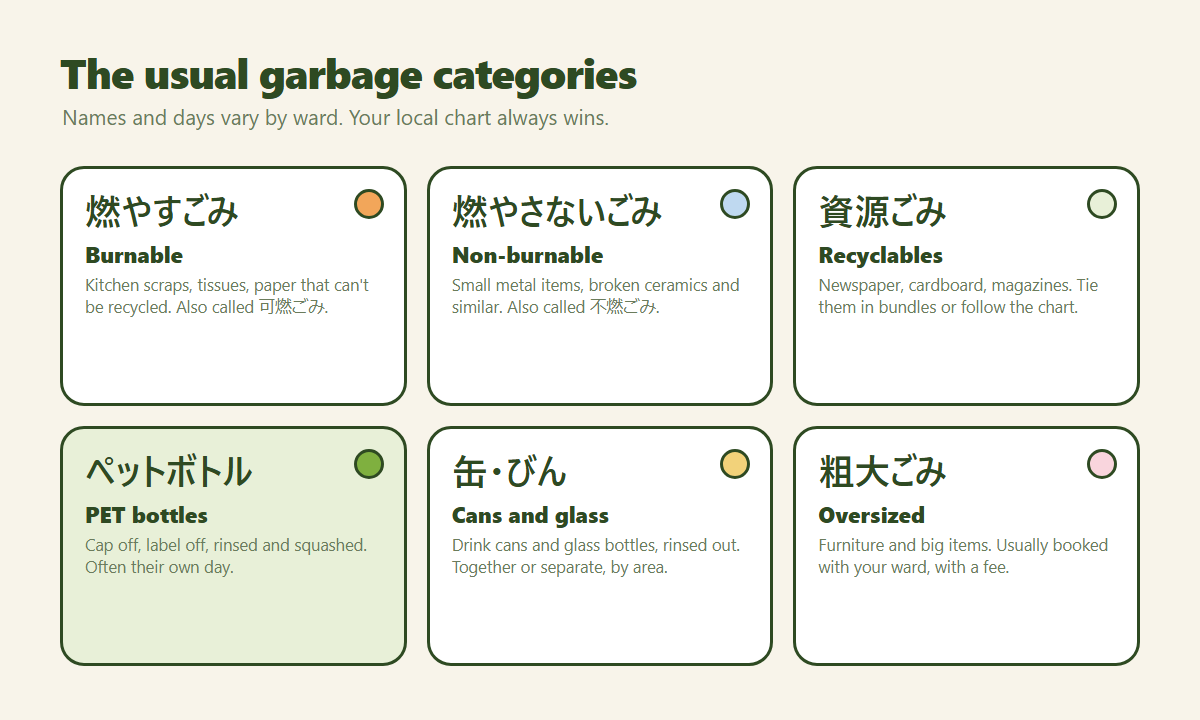
Kitchen scraps, paper that can't be recycled, tissues and similar everyday trash. Usually collected on more than one day a week.
Things like small metal items, broken ceramics and some small appliances. Often collected less often, so check the chart.
Newspapers, cardboard, magazines and other paper, and in many areas cans, glass bottles and PET bottles too. Usually tied in bundles or put in a set place.
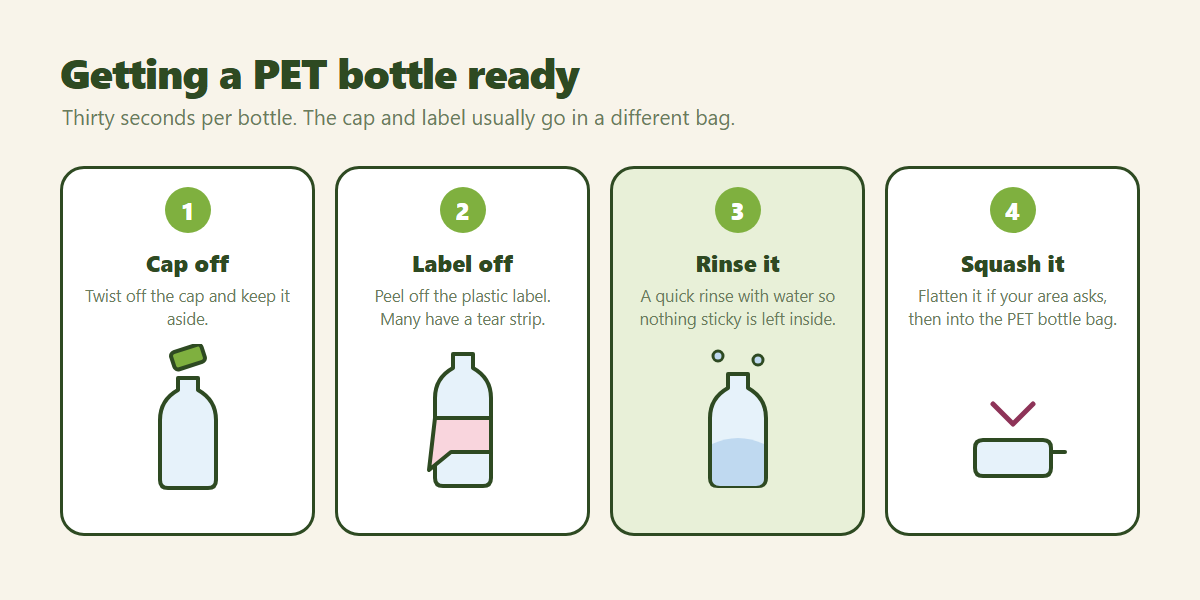
The plastic drink bottles. Often their own category, with caps and labels removed and the bottle rinsed.
Drink cans and glass bottles, rinsed out. Some areas collect them together, others separately.
Furniture, bicycles and other big items. These usually don't go to the normal collection point. You book a pickup with your ward and pay a fee, so check how yours does it.
Garbage day is one of those tiny routines that makes a new place feel like home. If you've just moved, our guide to your first visit to the ward office covers the registration you'll do around the same time (and is a good moment to ask for that sorting chart). Our first month in Tokyo guide has the rest of the basics, the konbini guide explains the shop you'll visit every day, and the coin laundry guide sorts out the other weekly chore. Living in a share house? Trash duty is usually shared, and comparing notes on the chart is an easy way to get talking.
Buy Me a Matcha is the only app made for English speakers to make real friends in Japan. See people near your station who also want new friends, send a matcha, and if they send one back, pick a café and meet one-on-one. Much more fun than reading a garbage chart.
Rules are set by your ward or city, so check your local sorting chart. Landlords, agents or the ward office often hand one out, and most wards publish theirs online. Some have English versions or a garbage app, and the sign at your building's collection point usually lists the days.
Common categories are burnable (燃やすごみ or 可燃ごみ), non-burnable (燃やさないごみ or 不燃ごみ), recyclables (資源ごみ), PET bottles (ペットボトル), cans and glass bottles (缶・びん) and oversized garbage (粗大ごみ). The exact names and rules vary by area.
Usually on the morning of the collection day for that category, by the time printed on your local chart. Putting it out the night before is often against the rules.
Furniture and other big items are usually oversized garbage (粗大ごみ). In many areas you book a pickup with your ward and pay a fee. Large home appliances like TVs and fridges usually follow a separate recycling process. Check your ward's website for the details.
In many areas, yes. People usually take off the cap and label, rinse the bottle and squash it. Caps and labels often go in a different category, so check your local chart.